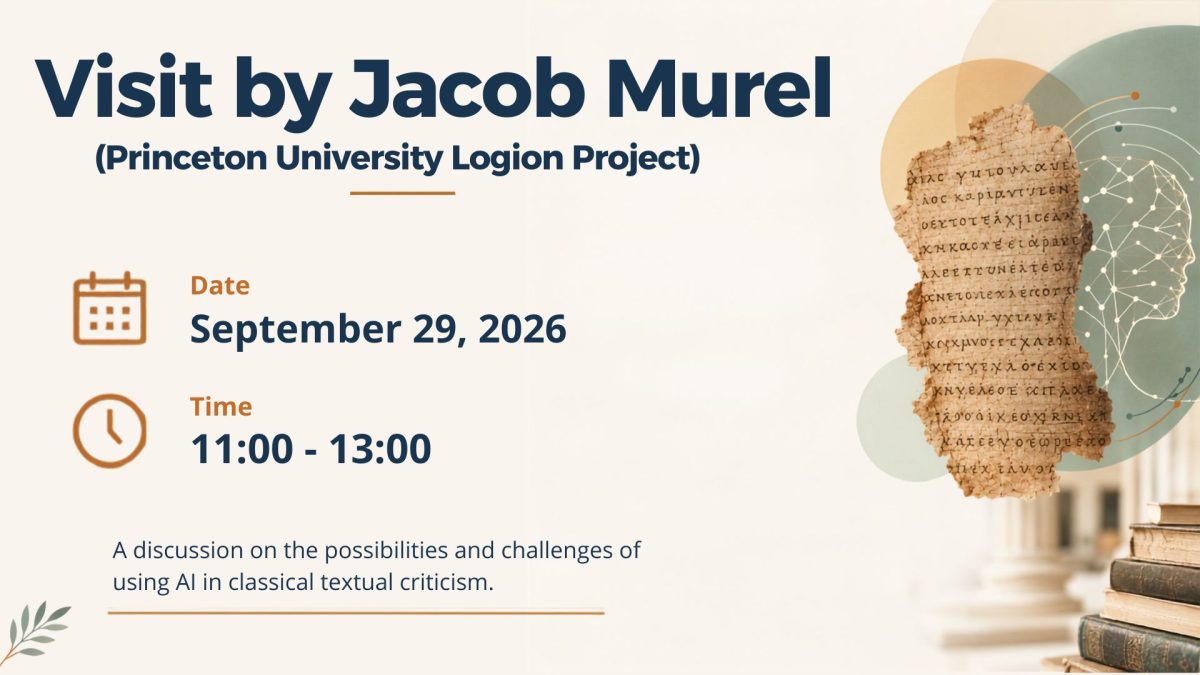
Visit by Dr Jacob Murel (Princeton University Logion Project) | Hybrid
TALOS AI4SSH at the University of Crete welcomes Dr Jacob Murel, Technical Lead of the Princeton University Logion Project, for a talk on the possibilities and challenges of using artificial intelligence in classical textual scholarship.
The Logion Project works to preserve and study premodern Greek texts. Its software lets researchers use language models for gap-filling and correcting scribal errors, without needing to write code. While these tools have already helped correct scribal errors in specific cases, their use raises broader questions about how AI can meaningfully support research in the humanities.
Dr Murel’s talk will address these core questions: how well current language model architectures suit philological tasks, how models for ancient languages should be evaluated, what practical needs should guide the design of tools for philologists, and how much of text reconstruction can reliably be automated. Drawing on the ongoing work of the Logion Project, the talk shows how these questions shape the development of practical AI tools for textual criticism.
Also speaking at the event, Dr Maria Papadopoulou, Director of the TALOS Lab, will present the Lab’s research, tools, and digital resources in classical philology and the digital humanities. TALOS RT1 PhD Candidate Rachel Milio will share her ongoing research on the ancient Attic orators.
Date: September 29, 2026
Time: 11:00–13:00 (GMT+3:00)
Venue: Onsite (TALOS Meeting Room, Γ3, Building Γ, KEME/UCRC, Rethymno) & Online (Zoom, passcode: 761267 )
Featured guest
Dr Jacob Murel is the technical lead of the Princeton University Logion Project, where he designs local AI systems to help scholars reconstruct premodern Greek texts. He has also worked on other digital humanities projects, including the Women Writers Project, Digital Humanities Quarterly, and the Open Islamicate Texts Initiative. His research focuses on using AI and computational tools to support scholars in textual criticism, paleography, and bibliography.
Talk
Title: Talos versus Medea: Bridging the tensions between AI and classical philology
Speaker: Dr Jacob Murel (Technical Lead, Princeton University Logion Project)
Abstract:
The past few years have seen a number of papers and research efforts applying AI developments to ancient languages. Among these is the Princeton University Logion Project. A core concern of the Logion Project is developing meaningful tools to assist in the preservation of the global archive of premodern Greek texts. To this end, the project has built a no-code software for LM inference with gap-filling and scribal error correction. These tools have demonstrated localized success in correcting scribal errors of premodern Greek. But ongoing work requires addressing a number of unresolved tensions between AI and philology: How suitable are current model architectures for philological tasks? How should ancient language LMs be evaluated for philological tasks? What practical concerns guide the development of AI tools that meaningfully assist philologists? How do we negotiate the role of automated processes in text reconstruction? This talk surveys the Logion Project’s ongoing efforts to address these issues in building meaningful AI applications to assist in classical textual criticism.
Additional presentations
- TALOS Lab research activities, tools and digital resources: Dr Maria Papadopoulou (Director of the TALOS Lab)
- Research on the corpus of ancient Attic oratory: Rachel Milio (TALOS RT1 PhD Candidate)