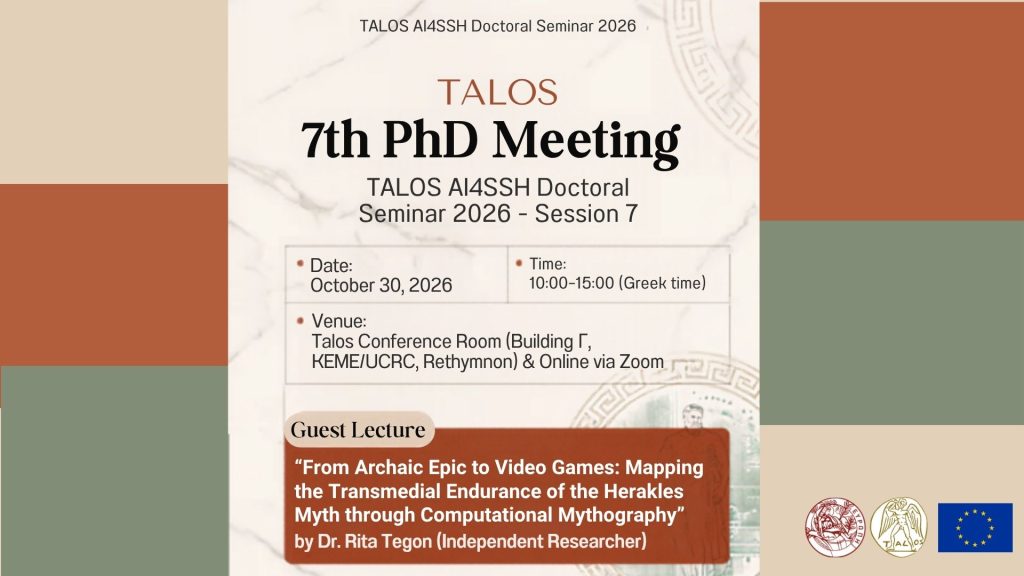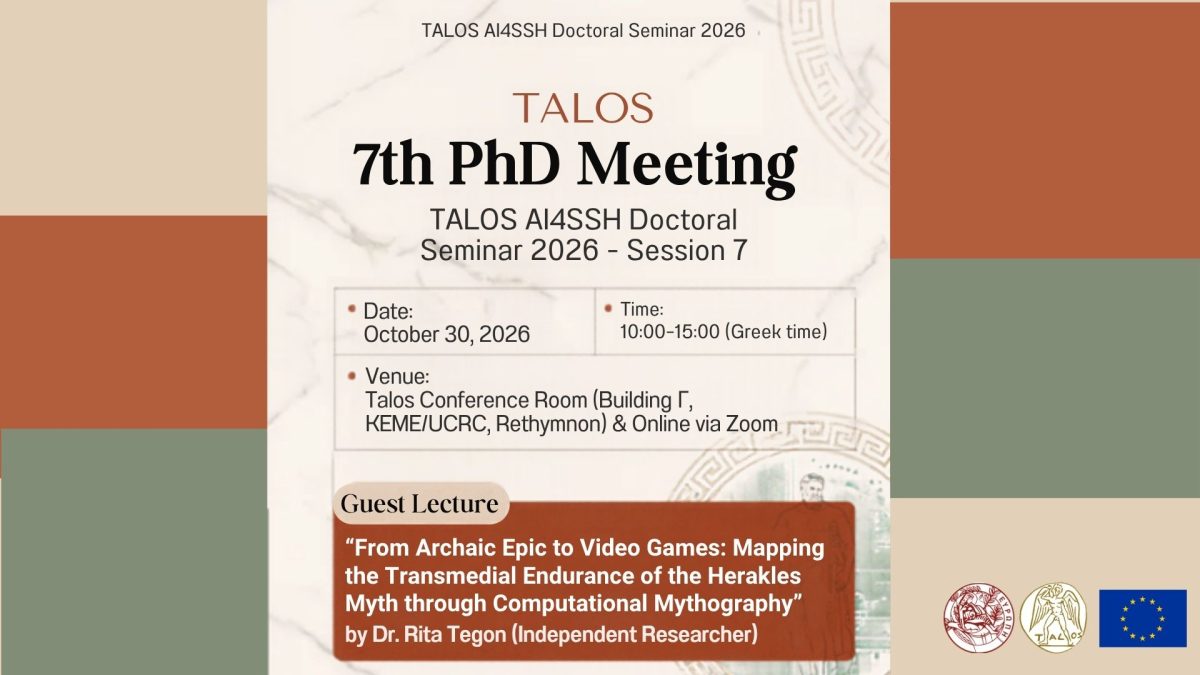
TALOS 7th PhD Meeting
The TALOS Lab is pleased to announce the 7th TALOS PhD Meeting, part of the TALOS AI4SSH Doctoral Seminars. The meeting will take place in a hybrid format, onsite in Rethymno and online.
Date: October 30, 2026
Time: 10:00 – 15:00 (Greek time)
Venue: TALOS Conference Room, Building Γ, KEME/UCRC (Rethymnon) & Online
Zoom link: https://uoc-gr.zoom.us/j/83796314520?pwd=0aa5JV2HjQnbbpvl2c2Eu03NaKLioC.1
Passcode: 769923
Meeting ID: 837 9631 4520
Contact: Maria Papadopoulou ()
PhD group convenor: Fotini Koidaki ()
The TALOS PhD Meeting series offers researchers a forum to present ongoing work, exchange feedback with peers, and discuss methodological and conceptual questions across digital humanities, archaeology, literature, and computational approaches.
In this seventh session, PhD candidates will present their current research on topics including imperfect data in the Digital Humanities, ont(otermin)ologies and iconographic metadata, the encoding of nineteenth-century Ionian prose fiction for Natural Language Processing, and the transformation of curriculum texts into formal ontologies. The programme will also feature a guest lecture by Dr Rita Tegon, an independent researcher, on the transmedial endurance of the Herakles myth, from archaic epic to contemporary video games, through computational mythography.
Abstract
Herakles has survived madness, poisoned robes, the weight of the celestial sphere, and 2,800 years of cultural and medial disruption. That the oldest hero of the Greek world should persist into forty-five video games released between 1983 and 2025 raises a fundamental problem for classical reception, digital humanities, and game studies: it exposes the lack of a rigorous, quantitative method for tracking mythological invariants as they migrate across radically disparate media. This keynote presents an end-to-end model for computational mythography. To compare domains traditionally seen as incommensurable, archaic hexameter and multimodal interactive virtual worlds, the investigation adopts a critical realist epistemology (Bhaskar) and introduces the principle of Operational Equivalence, showing how the Homeric periphrastic formula βίη Ἡρακληείη (“Herakles’ force”) and a digital damage multiplier are distinct empirical manifestations of the same underlying generative mechanism.
Across a programmatic six-dimensional taxonomy (somatic traits, personality, deeds, material culture, relational networks, and spatial distribution) applied to 202 ancient textual passages (8th- 5th c. BCE) and 45 video games (1983-2025) the computational and statistical analysis (Cliff’s δ, Mann-Whitney U, network modularity, geomythography) reveals profound structural shifts. Somatic representation exposes an “ancient ceiling effect” where muscularity remains invariant while hair specification explodes due to engine-level obligatory visuality. Network analysis captures a 25-fold edge proliferation, while character traits document a 7.34-fold decline in solitary heroic agency alongside a marked rise in collaboration.
Integrating Ian Bogost’s procedural rhetoric with Giorgio Agamben’s theory of the dispositivo, this talk argues that video games do not merely represent Herakles: they procedurally domesticate him, transforming the archaic solitary sufferer into a collaborative civiliser aligned with contemporary biopolitical and managerial governance. Herakles endures not despite medial transformation, but through it, preserving invariant hard cores while adapting his soft peripheries. Beyond the case study, the lecture addresses the practical and epistemological challenges of designing replicable, mixed-methods computational workflows across humanities corpora, culminating in the proposal of an open, FAIR-compliant, scalable, and reusable architecture.
Short Bio
Rita Tegon is an Italian researcher holding a PhD in Digital Humanities from the Universidad de Salamanca. With a Bachelor degree in Linguistics (Glottology) from the University of Padua, her research combines classical philology, digital humanities, game studies, AI ethics and computational approaches to cultural analysis, with particular attention to the transmedial reception of classical antiquity, gender-sensitive analysis, and the cognitive implications of artificial systems. She brings extensive experience in ancient Greek and Latin education, university tutoring, teacher education, public-sector evaluation, national digital innovation, and international project coordination.