Methodology of Formally Representing Genre Terminology in Archaic Greek Lyric
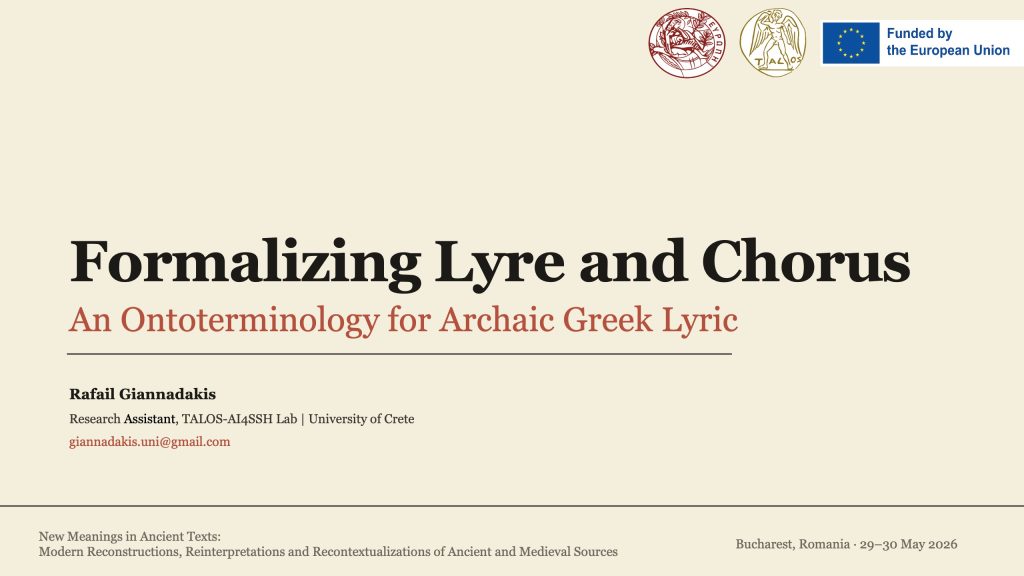
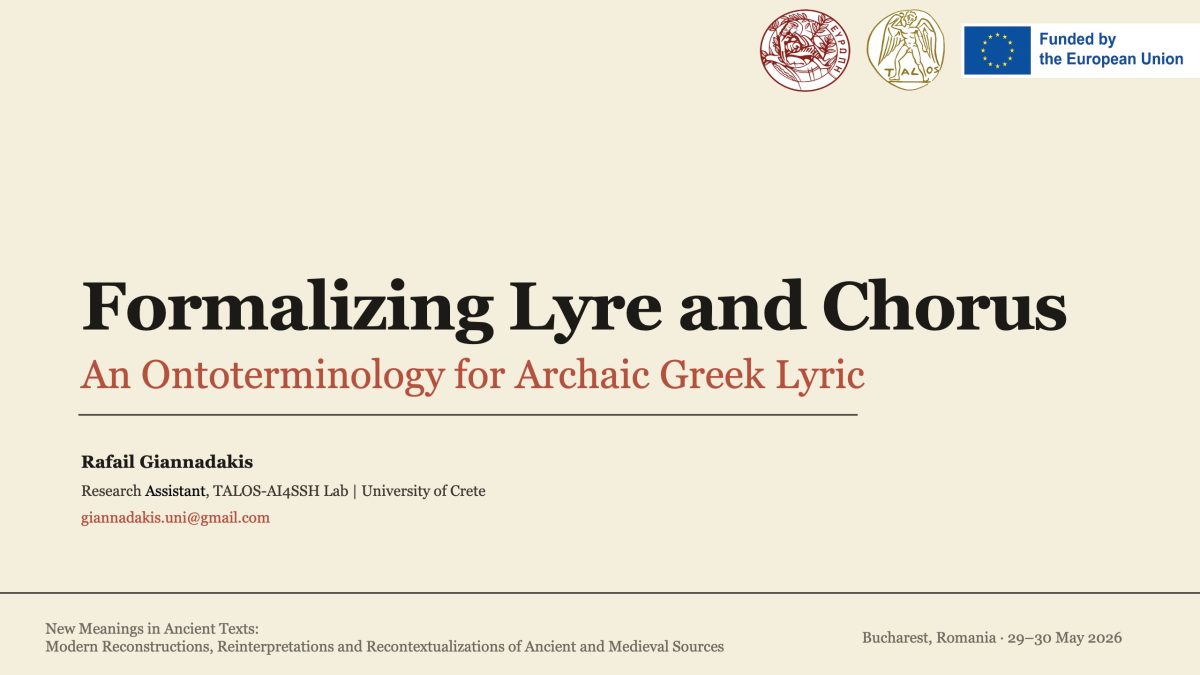
On May 29–30, 2026, TALOS Lab member Rafail Giannadakis participated in the international Romanian Colloquium, “New Meanings in Ancient Texts: Modern Reconstructions, Reinterpretations and Recontextualizations of Ancient and Medieval Sources” organized in Bucharest, Romania. He presented a paper on the methodology of formally representing genre terminology in archaic Greek lyric. The talk addressed the problem of defining poetic categories in a corpus marked by fragmentary transmission, reconstructed performance contexts, and historically layered terminology. It argued that genre classification, from ancient scholarship to modern philology, is itself an interpretive practice.
ALyrA, the Archaic Lyrical Agora, was presented as a case study in which modelling is carried out through the ontoterminology paradigm, combining terminological denotation with ontology-based knowledge representation. By defining subgenres through essential characteristics such as metre, dialect, performer, chorus type, occasion, dedication, and content, the project makes the criteria behind definitions explicit.
The talk also discussed how the TEDI software, linked data, RDF/OWL, SPARQL, and FAIR principles support research and teaching uses through TEDI HTML exports. The argument was that formalization can function as a philological method: it organizes uncertainty, exposes assumptions, and keeps the human expert responsible for interpretation.