TALOS participation in the 53rd CAA International Conference in Vienna
Earlier this month, TALOS researchers participated in the 53rd CAA International Conference (“It’s all about people”), held at the University of Vienna from 31 March to 4 April 2026.
Date: 31 March – 4 April 2026
Venue: University of Vienna, Austria
Conference website: https://2026.caaconference.org/
Programme: https://2026.caaconference.org/program/
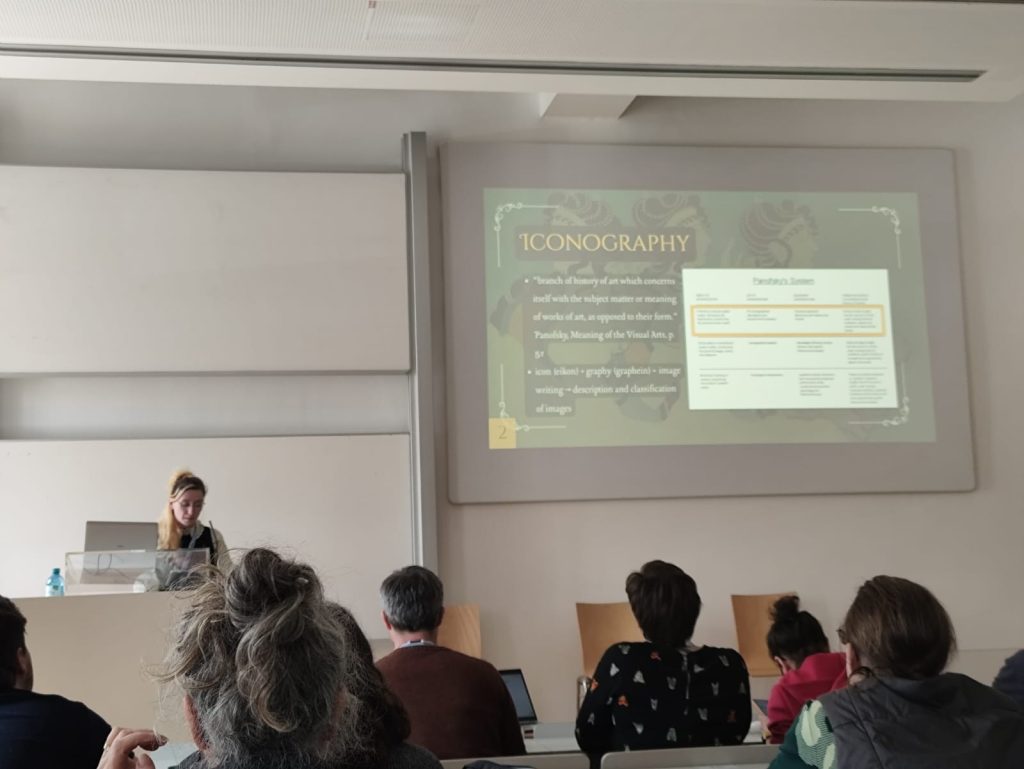
TALOS PhD candidate Melissa Bergoffen participated in Session 30, “Unstoppable Vision, Immovable Practice: An Adversarial Debate on Linked Open Dreams and the Reality of Archaeological Data Collection,” presenting the paper “Iconographic Metadata: From ‘Traditional’ Databases to Semantic Data.” Supervised by Artemis Karnava, Christophe Roche, and Maria Papadopoulou, the research explored how ontoterminologies can better retain complex iconographic metadata compared to standard relational databases. Using the “Ladies in Blue” Bronze Age Aegean wall painting from Knossos as a case study, the presentation demonstrated how a semantic, FAIR-driven approach can effectively integrate exhaustive descriptive frameworks into structured archaeological data. Specifically, it examined how semantic modeling accommodates Panofsky’s pre-iconographic analysis, Sourvinou-Inwood’s exhaustive methods for bias prevention, and Stansbury-O’Donnell’s narrative structural analysis, thereby preserving the deep interpretive nuances of art historical research.
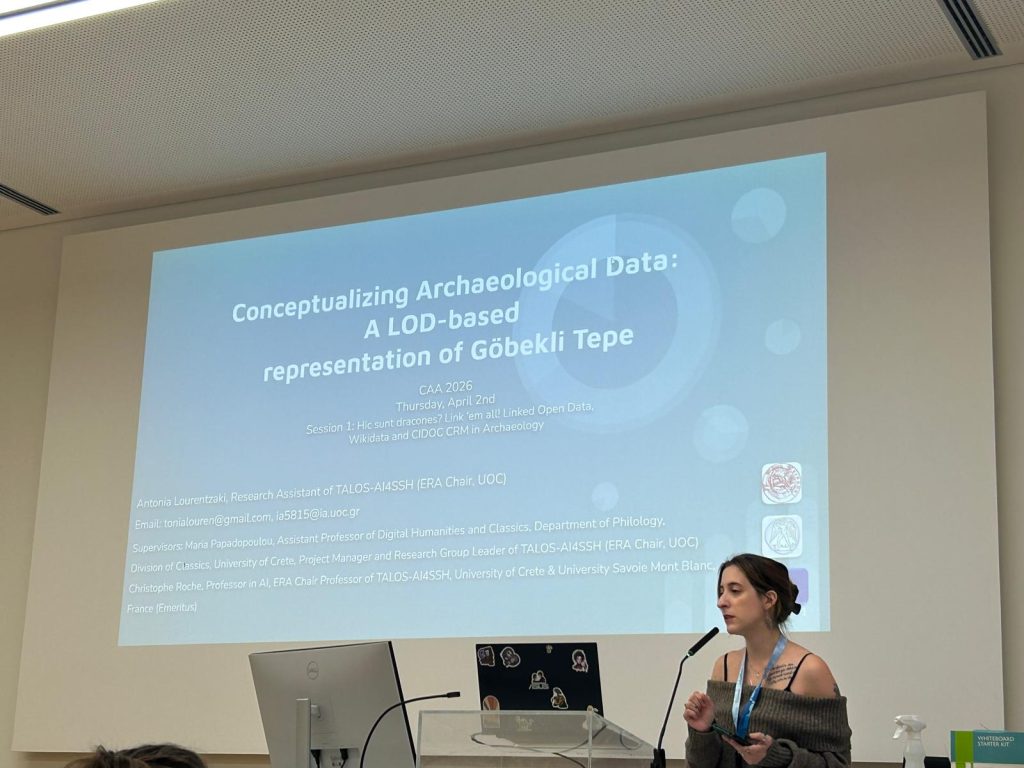
TALOS Research Assistant Antonia Lourentzaki participated in Session 1, “Hic sunt dracones? Link ‘em all! Linked Open Data, Wikidata and CIDOC CRM in Archaeology,” presenting the paper “Conceptualizing Archaeological Data: A LOD-based representation of Göbekli Tepe.” Co-authored with Maria Papadopoulou and Christophe Roche, the research detailed the formal representation of spatial, architectural, and artefactual data from the monumental site in Turkey using a FAIR Linked Open Data framework. The project addresses Göbekli Tepe’s dataset of high interpretive density, where monumental T-shaped pillars, reliefs, and ritual practices intersect. By developing a domain-specific ontoterminology and knowledge graph, the approach enables computational querying of these complex material records while maintaining strict epistemic clarity, carefully distinguishing between definitional certainty and interpretive or uncertain archaeological inferences.