


The 2nd Semantic Annotation for the Ancient World (SA4AW) conference examines the role of semantic annotation in dialogue with hybrid AI approaches, large language models (LLMs), deep learning, and knowledge graphs in the study of the ancient world and cultural heritage. Semantic annotation—whether manual, automated, or human-in-the-loop—enables the identification and linking of concepts, entities, and relationships, transforming raw textual and visual data into structured, interoperable knowledge. At a moment when LLMs can generate fluent interpretations but require grounding in domain-specific context, semantic annotation and knowledge graphs provide essential transparency, precision, and reusability. We welcome contributions that showcase methods, tools, case studies, theoretical reflections, and cross-disciplinary collaborations. In line with FAIR and Linked Open Data principles, the conference encourages open and accessible research practices.
Submissions: Submit abstracts (750-1000 words) at the EasyChair by February 15th.
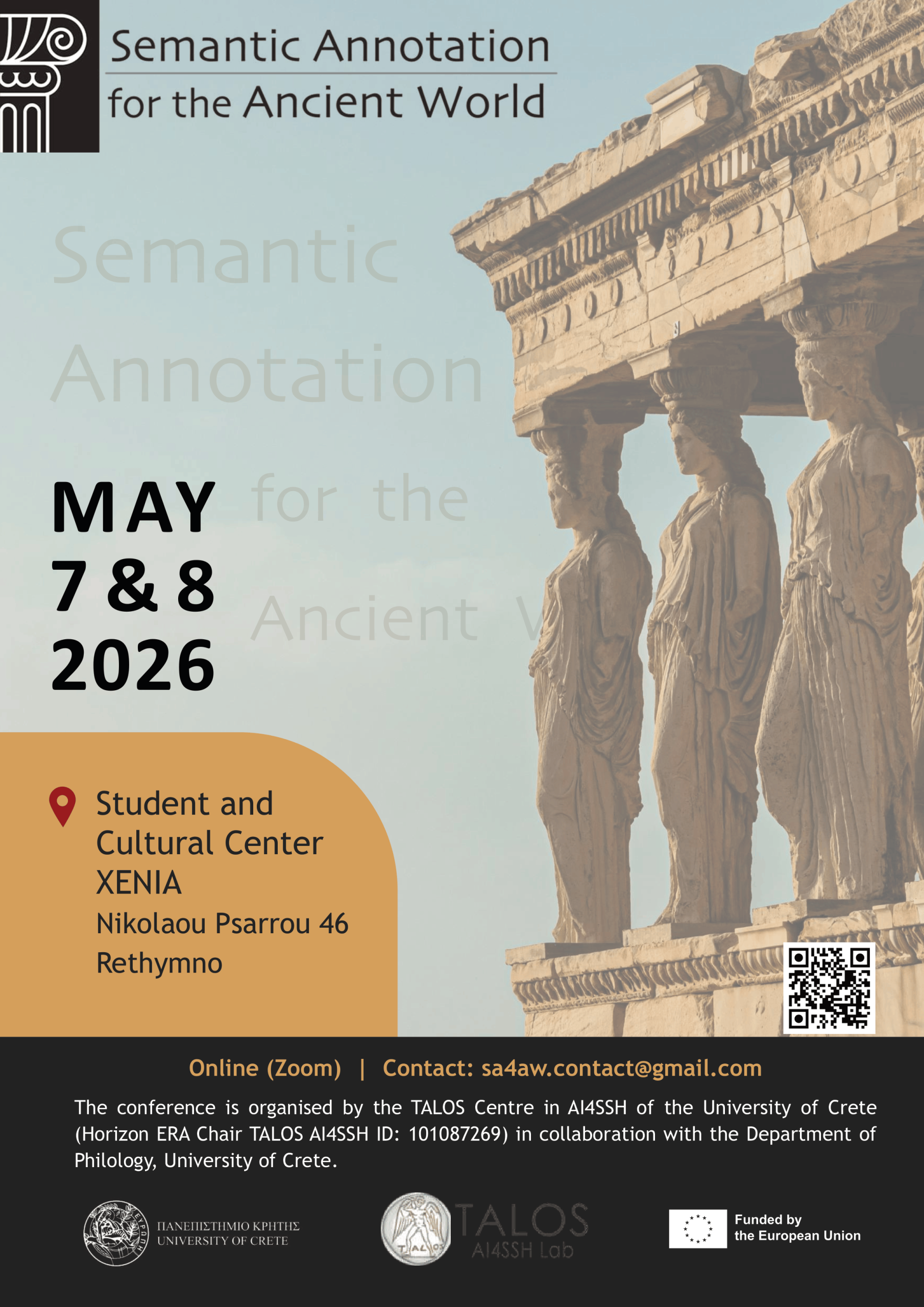
The conference is organised by the TALOS Centre in AI4SSH of the University of Crete (Horizon ERA Chair TALOS AI4SSH ID: 101087269) in collaboration with the Department of Philology, University of Crete.
- Ontology-driven semantic annotation
- Standardisation
- Multilingual annotation practices
- Automatic and semi-automatic annotation
- Annotation of ancient geography
- FAIR/LOD data
- Semantic Web
- NER for ancient Greek/Latin
- RDF-based digital editions
- Methods, tools, and platforms
CALL FOR PAPERS
CONFERENCE PROGRAM
Annie K Lamar (UC Santa Barbara, USA)
Low-Resource Languages and Epistemic Justice
Abstract
The rapid expansion of large language models and data-intensive AI is widening the gap in technological equity. Most cutting-edge LLMs and the annotated data used to train them systematically advantage high-resource languages. This trend threatens to further marginalize historical, scarce, and endangered linguistic datasets. The aggressive push toward algorithmic scale compounds this problem and enables extractive practices—what I call "digital prospecting"—that compromise community data sovereignty in favor of corporate model training.
This talk applies the framework of epistemic justice to AI development: specifically, its commitments to the fair distribution of epistemic resources and the recognition of non-dominant knowledge systems. Central to this intervention is the positioning of Classics as a 'model science'. By treating the small data environments of ancient Mediterranean languages as an opportunity for innovation rather than a limitation, we can develop "humanist-in-the-loop" methodologies that prioritize human expertise and allot interpretive authority to the communities whose linguistic heritage is at stake. This talk demonstrates how the rigorous constraints of computational classics provide a roadmap for building AI futures that are ethical, transparent, and linguistically diverse.
Bio
Annie K. Lamar is Assistant Professor of Computational Classics and Director of the Low-Resource Language (LOREL) Lab at the University of California, Santa Barbara. Her research sits at the intersection of classical philology, natural language processing, and computational humanities, with a sustained focus on multilingual vector stability. She has published on machine translation, geospatial computation, and the linguistic marginalization of underrepresented communities in AI infrastructures. Her public writing has appeared in Newsweek, Tech Policy Press, and Inside Higher Ed. She holds an MA in Education Data Science and a PhD in Classics from Stanford University.
Terhi Nurmikko-Fuller (RMIT University, Australia)
Oh LAWD, oh LAWD, oh LAWD: Reflections on Linked Ancient World Data projects
Abstract
The Linked Ancient World Data Initiative ran its first iterations in 2012 and 2013. This event was a pivotal moment, creating communities, collaborations, and publications. This talk will discuss example projects within this space, highlight the value of applying semantic technologies to ancient world data, and celebrate the communities which have engaged and pioneered in this niche specialism. It pulls on heuristics of past projects, flags the dangers of presentism, and asks whether digital technologies that have been built from the omniscient perspectives of complete, clean, and modern data can truly be applied to the incomplete, ambiguous, and heterogenous datasets that map the ancient world in ways that are accurate, true, or even simply unproblematic.
Bio
Dr Terhi Nurmikko-Fuller is an Associate Professor, Information Interaction at the School of Computing Technologies at RMIT University in Melbourne, Australia. Her interdisciplinary research examines different methods for data linking and integration, and how digital technologies support and diversify research. She is the author of “Linked Data for Digital Humanities” (2023, Routledge), and has publications that cover a range of topics from the use, development, and critical evaluation of Linked Data to gamification and informal online environments in education. She has also created 3D digital models for the British Museum (cuneiform tablets), the National Museum of Australia (carved boab nuts), and UNESCO (Fels Cave in Vanuatu). Terhi is an Honorary Associate Professor at POLIS, the Centre for Social Policy and Research at the Australian National University; a member of the Territory Records Advisory Council, Policy and Cabinet Division, of the Chief Minister Australian Capital Territory Government; and a co-chair of the Australian Government Linked Data Working Group.
Participation in SA4AW is free of charge!
Register for online participation here.
TRAVEL INFORMATION
Travel to Crete
The University of Crete is located in Rethymno, Crete.
Rethymno is equidistant between two international airports, Chania (CHQ) and Heraklion (HER).
Journey time from either airport to Rethymno is approximately an hour via bus. From CHQ, the KTEL bus service will bring you directly to Rethymno.
From HER, there is a smaller local bus which will bring you to the central Heraklion bus station where you can catch a KTEL bus to Rethymno.
For information on the KTEL bus schedule, visit this site.
Accommodation in Rethymno
Rethymno sees a lot of tourists in the summer months, so there are plenty of options for accommodation.
We recommend Jo-An Palace, Achillion Palace, Theartemis Palace, Liberty Hotel, or Olympic Palladium, which are all centrally located in Rethymno.
Travel to Conference Venue
“XENIA”, the Student and Cultural Center at the University of Crete, is located in downtown Rethymno at Nikolaou Psarrou 46. The venue is walking distance from hotels in the city center.
For participants staying outside of the center of Rethymno, the University bus runs through the city center every twenty minutes. Tickets for the bus can be purchased at a variety of kiosks throughout the city, and cost 1,40 euro (0,70 for students). Look for the bus labelled University/Πανεπιστήμιο.
Local Information
For more about Rethymno and the University of Crete, you can visit the following sites:
IMPORTANT DATES
Assist. Professor in Digital Humanities & Classics, TALOS AI4SSH &
Department of Philology (University of Crete)
PROGRAM
COMMITTEE
- Elton Barker
- The Open University
- Monica Berti
- Universität Leipzig - Institut für Informatik
- Antonis Bikakis
- University College London
- Nelson Henrique Da Silva Ferreira
- University of Coimbra
- Eleni Gkadolou
- British School at Athens
- Leif Isaksen
- University of Exeter
- Alek Keersmaekers
- KU Leuven
- Maxim Kupreyev
- OPERAS RI
- Annie Lamar
- UC Santa Barbara
- Eleonora Litta
- Università Cattolica del Sacro Cuore
- Delfim Leão
- University of Coimbra
- Anna Novokhatko
- Albert-Ludwigs-Universität Freiburg
- Terhi Nurmikko-Fuller
- Australian National University
- Chiara Palladino
- Durham University
- Silvia Piccini
- Istituto di Linguistica Computazionale, Pisa
- Christophe Roche
- University of Savoie